The Short Version
I give every new game two hours. Not because that is enough to finish anything, but because it is enough to learn whether the game understands the kind of time I actually have.
I am usually playing after the kids are asleep. The window is short. Energy is limited. If a game spends those first two hours teaching me systems, filling the map with icons, or making me feel behind before I have even started, I already know the relationship is going to be difficult.
Here is the simple filter I use. It has saved me more evenings and more money than any review score.
A good game should earn your evening. The first two hours are the audition.
The Two-Hour Test
I ask four practical questions while I play. I do not need perfect answers. I need clear signals.
1. Can I feel real progress before the two hours are up?
Some games spend the entire opening on setup. Character creation, long cinematic, multiple tutorial zones, skill-tree explanations, inventory management. By the time the “real game” starts, the evening is gone.
The games that respect limited time give me a complete small loop early. I set a goal, pursue it, succeed or fail in a readable way, and feel like something happened. When the two hours end I can point to a concrete result instead of a pile of unlocked menus.
If the first session is mostly orientation, I already know future sessions will carry the same overhead.
2. Does the game punish me for stopping?
Frequent, reliable saves matter. Generous checkpoints matter. A design that expects me to finish a forty-minute sequence before I can quit cleanly does not fit a life where a kid can wake up or energy can simply run out.
I deliberately stop at awkward moments during the test. If the game makes me anxious about losing progress, or if the only safe quit points are far apart, it fails this part of the test. I have enough low-level stress in the rest of life. I do not need it from a game at 10:30 p.m.
3. Is the onboarding proportional to the actual game?
A complex strategy game can justify a careful teaching sequence. A straightforward action game that still forces thirty minutes of forced tutorials and popup tips is telling me it does not trust me or itself.
The best openings teach through play. They give me the minimum I need and then get out of the way. When a game over-explains simple mechanics or gates basic movement behind dialogue, I start watching the clock. That time is coming out of the limited window I have for actual enjoyment.
4. Do I feel behind before I have even started?
Many modern games open by showing me a massive skill tree, a crowded map, or a long list of systems I have not touched yet. The message is clear: there is a lot to do and you are already late.
I want the opposite feeling. I want the game to present a manageable next step and let me succeed at it. If the first two hours leave me more aware of everything I have not done than of what I just accomplished, the design is optimized for players with far more free time than I have.
What Passing Looks Like
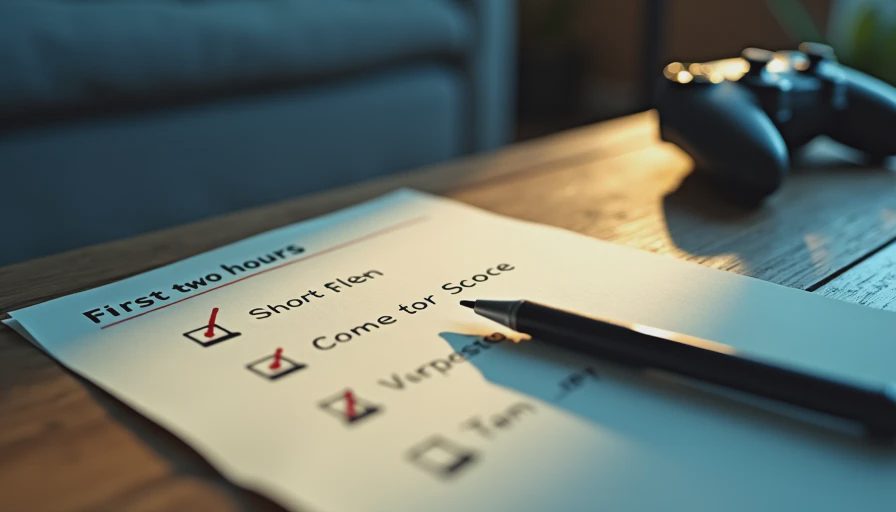
When a game passes the two-hour test, the session usually feels like this:
I boot it up, learn the core controls quickly, complete one or two meaningful segments, and reach a natural stopping point. I put the controller down knowing what I will do next time and feeling no guilt about stopping. The game has already shown me it can deliver a complete small experience inside the window I actually have.
Those games stay in the rotation. I return to them because the relationship already feels fair.
What Failing Looks Like
Failing games share a few patterns. The opening is front-loaded with systems. The map or menu immediately feels overwhelming. Progress is gated behind long mandatory sequences. Stopping requires planning. After two hours I mainly feel like I have been briefed for a job rather than invited to play.
I used to push through those openings out of stubbornness or because the reviews were strong. Now I treat the two-hour mark as a real decision point. If the signals are bad, I uninstall and move on. There are too many other games and too few quiet evenings to spend them on something that has already shown it will be high-maintenance.
Why Two Hours Is Enough
Two hours is long enough to see the design priorities. It is short enough that I have not yet sunk so much time that I feel obligated to continue. It matches the length of a solid evening session, so the test itself uses the same resource the game will later demand.
I do not need to finish the story or master every system. I only need to know whether the game and my life are compatible. The first two hours almost always give me that answer if I am honest about what I am feeling.
Final Thought
You are allowed to quit early. You are allowed to decide that a game’s opening has already told you what you need to know. The industry will keep making titles that assume unlimited player time. You do not have to keep accepting the assumption.
Protect the evenings you actually get. Use the first two hours as a filter. Keep the games that pass. Let the rest go without guilt.
A good game should earn your evening. The ones worth keeping start earning it right away.
No comments yet — grab the first one.